


Window thermal performance is mainly controlled by three specification groups: U-value or U-factor, SHGC or solar factor, and air leakage / water / structural performance. For architects, builders, developers, and window buyers, the practical question is simple: which values do you need for your climate, building type, and energy code?
This guide explains U-value, SHGC, thermal breaks, Low-E glass, whole-window performance, and common energy-code language in a buyer-friendly way. If you are sourcing aluminum windows for a project, use it as a specification checklist before requesting a quotation. For product options, review SGL's aluminum window systems and thermal break aluminum window options.
CTA: Ask SGL to Review Your Window Specification
Microcopy: Send your project country, building type, window schedule, glass requirement, U-value target, SHGC target, and opening drawings.


The Fundamentals: What Makes a Window "Thermally Efficient"?
A window's thermal performance is determined by how much heat it allows to pass through - both conducted heat loss through the material and solar radiation gain through the glass. These are two separate phenomena requiring separate metrics:
| Item | English Term | Also Called | Meaning | What a Lower/Higher Value Means | Best For |
|---|---|---|---|---|---|
| Conductive Heat Transfer | U-value / U-factor | Thermal transmittance | Heat passing through the window due to the temperature difference between indoors and outdoors | Lower U-value = less heat loss = better insulation | General evaluation of window insulation performance |
| Solar Radiation | SHGC | Solar Heat Gain Coefficient / Solar Factor / g-value | Solar energy transmitted through the glass into the building as heat | Lower SHGC = less solar heat enters = cooler interior; Higher SHGC = more solar heat gain = warmer interior | Lower SHGC for hot climates; Higher SHGC for cold climates |
U-Value (Thermal Transmittance): The Complete Explanation
What Is U-Value?
U-value measures how quickly non-solar heat moves through a building element. In window specifications, it is often written as W/m²K. In North America, the same idea is usually called U-factor and is written in Btu/h·ft²·°F.
For buyers, the most important rule is this: compare the complete window, not only the glass. A glazing unit can have a strong center-glass value, but the final window may perform worse once the frame, spacer, edge losses, seals, and installation conditions are included.
The National Fenestration Rating Council explains U-factor as a product rating for heat transfer. ENERGY STAR also uses U-factor and SHGC requirements by climate zone for residential windows, doors, and skylights.
Whole-Window vs. Center-Pane U-Value
This is one of the most important distinctions in window thermal specification - and a common source of misleading claims:
| Term | What It Measures | Typical Value (good DG window) |
|---|---|---|
| Ug (Glazing unit U-value) | Heat transfer through the center of the glass only | 0.6–1.1 W/m²K |
| Uf (Frame U-value) | Heat transfer through the frame only | 1.0–3.0 W/m²K |
| Uw (Whole-window U-value) | Weighted area average of Ug + Uf + thermal bridge at edge | 1.0–2.5 W/m²K |
Critical Warning: Many marketing materials quote Ug (center-pane) U-values that are significantly better than the Uw (whole-window) value. A triple-glazed unit may have Ug = 0.7 W/m²K but Uw = 1.2 W/m²K once the frame and edge losses are included. Always specify and compare Uw (whole-window) values for compliance and energy modeling purposes.
U-Value Units: W/m²K vs. BTU/(h·ft²·°F)
North American standards (NFRC, IECC) use U-factor in BTU/(h·ft²·°F) while all other major markets use U-value in W/m²K. The conversion:
U-value (W/m²K) = U-factor (BTU/h·ft²·°F) × 5.678
Useful reference conversions:
| U-value (W/m²K) | U-factor (BTU/h·ft²·°F) |
|---|---|
| 0.5 | 0.088 |
| 0.8 | 0.141 |
| 1.0 | 0.176 |
| 1.2 | 0.211 |
| 1.4 | 0.247 |
| 1.6 | 0.282 |
| 2.0 | 0.352 |
| 2.5 | 0.440 |
| 3.0 | 0.528 |
SHGC, Solar Factor (g-value), and Total Solar Energy Transmittance
What Is SHGC?
Solar Heat Gain Coefficient (SHGC) - the North American term - measures the fraction of solar energy that passes through a window and enters the building as heat. It includes both directly transmitted solar radiation and the portion of absorbed solar energy that is re-radiated inward.
Scale: 0 to 1 (0 = no solar heat passes through; 1 = all solar heat passes through)
Clear glass: SHGC approximately 0.82–0.87
Standard Low-E double glazing: SHGC approximately 0.25–0.50 depending on coating
Solar control glazing: SHGC approximately 0.20–0.25
SHGC vs. g-value vs. Solar Factor
These three terms describe the same physical phenomenon but are used in different regional standards:
| Term | Region Used | Standard |
|---|---|---|
| SHGC | North America | NFRC / IECC |
| g-value (solar factor) | Europe / UK | EN 410 / EN 14351-1 |
| Solar factor | Australia | AS/NZS 4667 / WERS |
Numerically equivalent - an SHGC of 0.40 = g-value of 0.40 = solar factor of 0.40. The metric is identical; only the terminology differs by region.
Why SHGC Matters More Than Many Specifiers Realize
In hot climates, a window with SHGC 0.25 versus 0.50 can reduce cooling energy demand by 15–30% for a west-facing office facade. This is often more impactful than the U-value difference between double and triple glazing.
Conversely, in cold climates with significant solar access, high-SHGC south-facing windows (northern hemisphere) can provide passive solar heating that reduces heating demand - meaning that always specifying low-SHGC is actually an energy penalty in cold climates.
The optimal SHGC strategy:
- Hot climates (UAE, QLD, FL, TX): Low SHGC (0.20–0.30) across all orientations
- Cold climates (Canada, Scandinavia, UK North): Moderate-to-high SHGC (0.40–0.60) for south-facing; low (0.25–0.35) for east/west
- Mixed climates: Model it - orientation-specific specification is most effective
What Is a Thermal Break in Windows?
The Problem with Standard Aluminum
Aluminum is an excellent structural material - but it conducts heat approximately 1000× better than UPVC and 8,000× better than still air. In a standard (non-thermal-break) aluminum window frame, this high conductivity creates a continuous "thermal bridge" between the cold exterior and warm interior:
- Interior condensation: Cold aluminum surface drops below dew point, causing moisture condensation on frames
- Discomfort: Cold radiant surface reduces occupant comfort near windows
- High U-value: Standard aluminum frame Uf ≈ 3.5–7.0 W/m²K - dramatically worsening whole-window thermal performance
- Energy code non-compliance: Standard aluminum frames typically fail energy code requirements in all but the warmest climate zones
How Thermal Break Construction Works
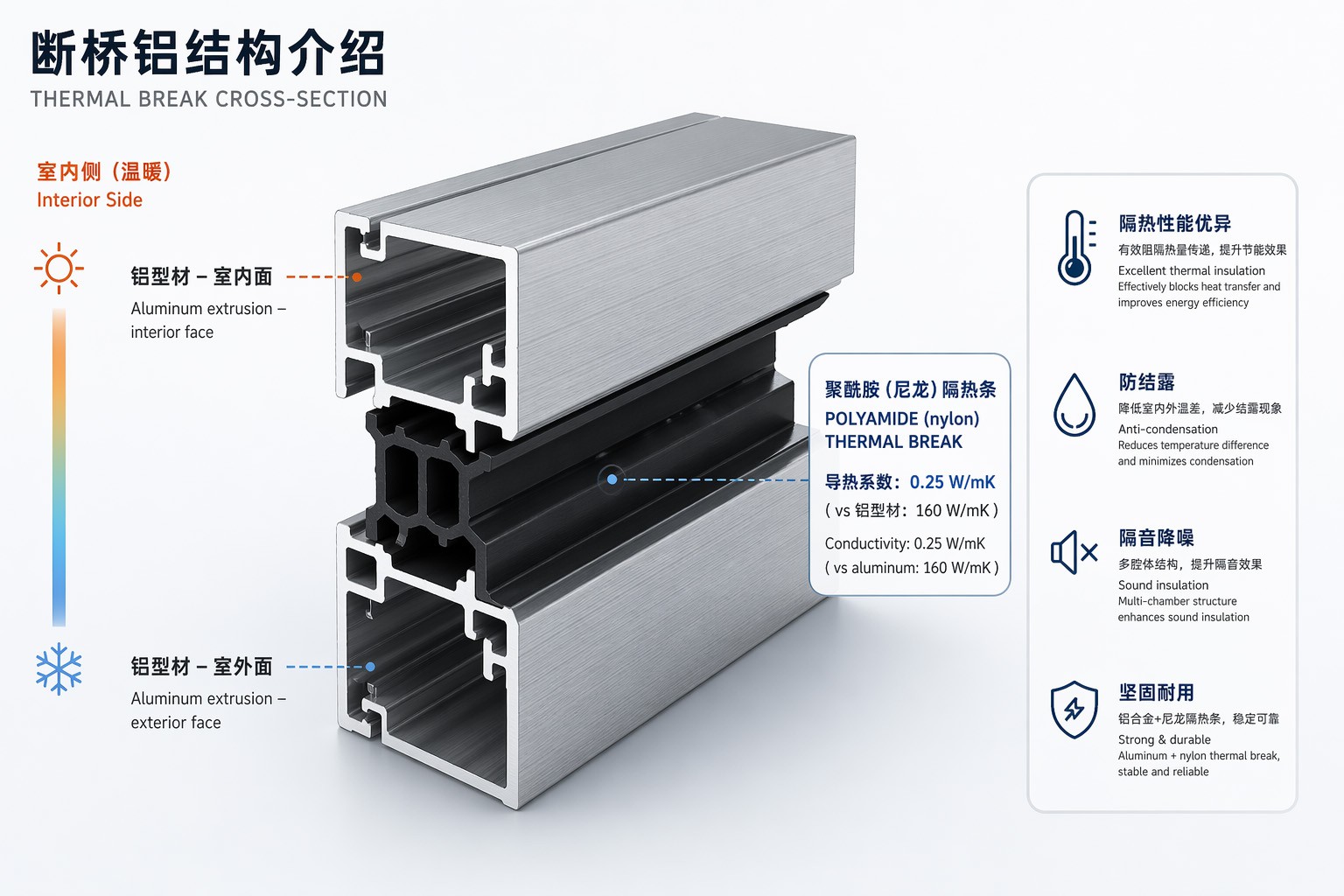
A thermal break (also called thermal barrier) interrupts the aluminum's conductive path by inserting a strip of low-conductivity material between the interior and exterior aluminum sections:
Thermal break materials:
- Polyamide (nylon/PA66): Most common, excellent structural properties, 20mm–40mm typical width
- Polyurethane foam (PU): "Poured and debridged" construction; slightly better thermal performance but less structural efficiency
- Composite profiles (fiberglass, plastic): Used in highest-performance systems
Thermal Break Width vs. Performance
Wider thermal breaks generally improve frame U-values, but with diminishing returns:
| Thermal Break Width | Approximate Frame Uf | Application |
|---|---|---|
| 0mm (no break) | 3.5–7.0 W/m²K | Non-compliant in most regulated markets |
| 20mm polyamide | 2.0–2.8 W/m²K | Entry-level compliance; warm climates |
| 28–32mm polyamide | 1.4–2.0 W/m²K | Standard specification; most regulated markets |
| 40mm+ polyamide | 0.9–1.4 W/m²K | Enhanced performance; cold climates |
| Poured PU + widened break | 0.6–1.0 W/m²K | Near-passive house specification |
SGL's Thermal Break Range: Our thermal-break aluminum windows feature 28–40mm polyamide breaks depending on product series, achieving whole-window Uw values from 0.9 to 1.6 W/m²K depending on glazing unit specification.
International Standards and Code References
| Market | Common Performance Language | Buyer Action |
|---|---|---|
| United States | U-factor, SHGC, visible transmittance, air leakage, IECC climate zones, NFRC label | Ask for NFRC-style rating data and confirm project climate zone. |
| ENERGY STAR / North America | U-Factor and SHGC by climate zone | Check whether the product target aligns with ENERGY STAR criteria for the project region. |
| Europe / UK | Uw, Ug, g-value, EN standards, national energy requirements | Confirm whole-window Uw and local project requirements. |
| Australia | U-value, solar factor, WERS / NatHERS-style modeling | Confirm climate zone and cooling-load priority. |
| Middle East / hot climates | SHGC, shading coefficient, solar control glass, cooling load | Prioritize solar control, frame finish, glass color, and facade orientation. |
For official U.S. energy-code context, check the International Energy Conservation Code residential energy efficiency chapter. For product-label language, use NFRC and ENERGY STAR windows, doors and skylights as reference points.
How to Choose Glass and Frame Combinations
| Project Need | Recommended Review |
|---|---|
| Hot climate / high solar exposure | Low SHGC glass, solar-control Low-E, durable frame finish, shading strategy. |
| Cold climate / heating-dominated project | Lower U-value, thermal break frames, Low-E insulated glass, warm-edge spacer, condensation review. |
| High-rise building | Wind load, water tightness, structural performance, safety glass, installation method, thermal/acoustic comfort. |
| Hotel or apartment | Acoustic glass, Low-E glass, thermal comfort, repeatable unit sizes, maintenance access. |
| Commercial facade | Commercial aluminum window systems, shop drawings, performance documentation, drainage, hardware durability. |
For related SGL pages, review commercial aluminum window systems and efficient windows for high-rise buildings.
What Buyers Should Ask Suppliers to Confirm
- Is the quoted U-value for glass only or for the whole window?
- Which standard or test method supports the U-value, SHGC, air leakage, and water tightness values?
- Is the frame standard aluminum or thermal break aluminum?
- What Low-E coating and glass build-up are used?
- Are warm-edge spacers available?
- Are the values suitable for the project climate zone and building code?
- Can the supplier provide test reports or rating documentation before order confirmation?
- Can the same system meet wind load, water tightness, air leakage, acoustic, and safety glass requirements?
CTA: Request a Thermal Performance Review
our Products


Conclusion: Thermal Performance Is Now a Core Specification Competency
Understanding U-value, SHGC, and thermal break technology is no longer optional for building professionals - it's a core competency required for regulatory compliance in virtually every regulated construction market.
The key principles to carry forward:
- Always use Uw (whole-window), never Ug (center-pane) for compliance and comparison
- SHGC is climate-dependent: low in hot climates, higher (south-facing) in cold climates
- Thermal breaks are mandatory for aluminum windows in any energy-regulated market outside tropical zones
- Triple glazing makes sense above certain performance thresholds (Uw < 1.0) but adds cost, weight, and reduced visible light
- Warm-edge spacers make a measurable difference in cold climate compliance
- Request certified data, not marketing claims - NFRC, WERS, CE, and BFRC labels provide independently verified performance data
- At SGL Doors & Windows, we provide full certified thermal performance data for all our product ranges across the major international rating systems. Our technical team can advise on optimal glazing and frame combinations for any climate zone, building type, and certification requirement.
FAQ About Window U-Value, SHGC and Thermal Performance
What is a good U-value for windows?
A good U-value depends on the project location, building type, climate zone, and local energy code. In general, lower U-value means better insulation. For code or energy-modeling work, ask for whole-window U-value, not only center-glass U-value.
Is U-value the same as U-factor?
They describe the same heat-transfer concept but use different units. U-value is commonly expressed in W/m²K. U-factor is commonly used in North America in Btu/h·ft²·°F.
Is SHGC always better when it is lower?
No. Lower SHGC helps reduce solar heat gain in hot climates, but colder climates may benefit from carefully selected solar gain on certain orientations. SHGC should be reviewed with climate, orientation, shading, and energy modeling.
Do aluminum windows need a thermal break?
Not always. Standard aluminum may be acceptable for some mild or budget-driven projects. Thermal break aluminum is usually worth reviewing for air-conditioned buildings, cold climates, commercial projects, hotels, apartments, villas, and projects with energy-code requirements.
What is the difference between Uw, Ug and Uf?
Ug is the glass or glazing-unit U-value. Uf is the frame U-value. Uw is the whole-window U-value. For project comparison, Uw is usually the most useful value because it reflects the complete product.
What documents should I ask a window supplier for?
Ask for test reports, rating documentation, glass build-up, frame system details, air leakage data, water tightness data, wind load information, and any local compliance documents required for your market.
Can SGL help choose the right window specification?
Yes. Send SGL your project country, building type, drawings, window schedule, glass requirement, target U-value, SHGC target, and opening type. The team can review suitable aluminum window, thermal break window, or commercial window options.
CTA: Contact SGL for a Project Window Review
About SGL Doors & Windows

SGL Doors & Windows is a premier manufacturer of thermal-break aluminum windows and doors, UPVC/PVCu systems, steel windows, composite doors, and glass door solutions. With products certified to CE (EN 14351-1), AS2047, WERS-rated for Australia, and NFRC data available for North American projects, SGL delivers thermally compliant fenestration solutions across 30+ countries.
Thermal Performance Certifications: CE (EN 14351-1) | AS2047 | WERS Rated | NFRC Data Available
Products: Thermal-break aluminum (Uw from 0.9 W/m²K) | UPVC systems (Uw from 1.2 W/m²K) | Triple glazing options
Markets Served: UK, Australia, USA, Canada, UAE, Europe, Philippines, Singapore, and more
Website: https://www.sgl-doors-windows.com
Contact for Thermal Specification Support: Request Thermal Performance Data
Tags: thermal break windows, u-value windows, window u-value, SHGC windows, thermal performance windows, low-e glass, double glazing u-value, triple glazing, NatHERS windows, WERS rating, NFRC windows, Part L windows, Future Homes Standard windows, energy efficient windows, aluminum thermal break, SGL thermal windows


