The shear modulus used in a laminated-glass calculation belongs to a specific interlayer, temperature and load duration. Changing any of those inputs can change the calculated coupling between the glass plies-and the equivalent thickness used to assess deflection.
Why the Interlayer Matters
Laminated glass combines glass plies with an interlayer. Under bending, the interlayer can transfer shear between the plies, affecting how closely they act together.
In an effective-thickness model, that interaction is represented through the material properties and geometry. Adding the glass thicknesses alone does not describe it. Nor does the label "SGP" identify a complete design input.
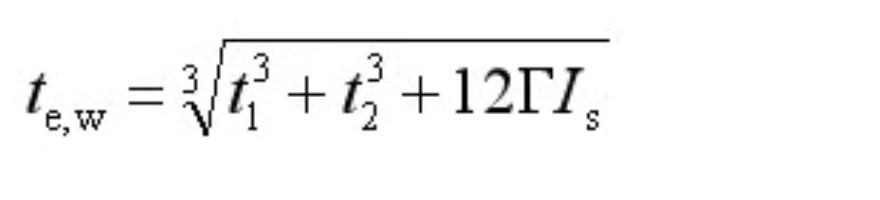
The source article uses tₑ,w, an effective thickness for deflection. This should be distinguished from the effective thicknesses used to assess stress in the individual glass plies.
Choose Data for the Exact Product and Conditions
The interlayer shear modulus, G, is not a fixed number for every calculation. Product identity, temperature and load duration belong beside the value in the design record.
Kuraray's architectural glazing product portfolio, checked on November 19, 2026, lists G = 11.3 MPa for SentryGlas at 50°C and one minute. At the same temperature and duration, it lists 3.89 MPa for SentryGlas Xtra.
These values show why a familiar product-family name cannot replace the exact material designation. They do not establish which product is appropriate for a particular project or which brand SGL supplies.
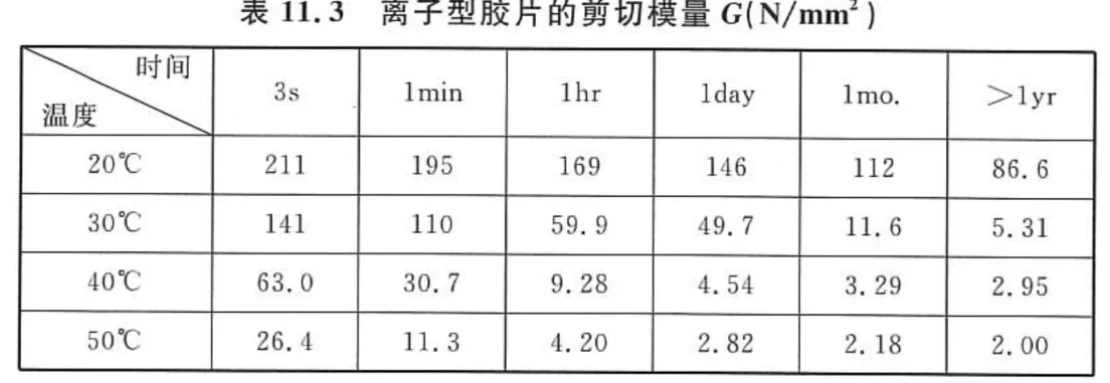
The ionoplast table reproduced in the November 2026 source article is shown for context. Columns represent load duration; rows represent temperature. The units, N/mm², are numerically equivalent to MPa. Use the selected product's applicable technical data for design rather than treating the reproduced table as universal.
The same discipline applies when comparing PVB and ionoplast interlayers. A broad material category is not a substitute for data for the specified grade and conditions.
Read the Formula Before Selecting a Coefficient
In the source model, Γ describes the degree of shear coupling. Its calculation uses G together with the glass elastic modulus, the interlayer thickness, the shorter panel dimension and geometric terms.
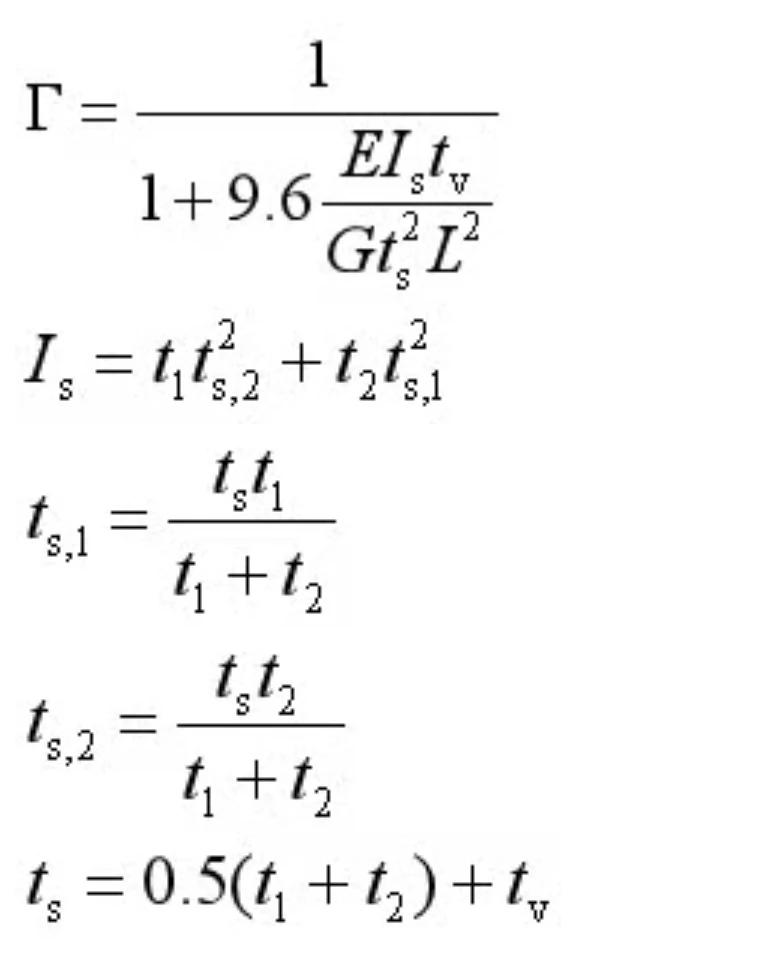
The source equations define Γ, Iₛ, tₛ,₁, tₛ,₂ and tₛ. Check the notation and units together before entering values in a spreadsheet.
Text transcription of the two principal equations:
Γ = 1 / [1 + 9.6 × E × Iₛ × tᵥ / (G × tₛ² × L²)]
tₑ,w = (t₁³ + t₂³ + 12 × Γ × Iₛ)^(1/3)
For the following example:
- t₁ and t₂ are the two glass-ply thicknesses, in millimetres.
- tᵥ is the interlayer thickness, in millimetres.
- L is the shorter panel dimension, in millimetres.
- E and G are expressed in N/mm².
The dimensions and support conditions must also suit the method being used. A correctly entered modulus cannot compensate for an inappropriate structural model.
Rechecking the 6 + 0.76 + 6 mm Example
The source article considers a 1.2 × 1.8 m panel with two nominal 6 mm glass plies and a 0.76 mm interlayer. It uses G = 11.3 N/mm².
To reproduce its arithmetic, the following calculation also explicitly assumes E = 72,000 N/mm² and L = 1,200 mm. The source screenshot defines E but does not state its numerical value; this assumption is added here for transparency.
1. Calculate the geometric separation term.
tₛ = 0.5 × (6 + 6) + 0.76 = 6.76 mm.
2. Calculate the two component distances.
tₛ,₁ = tₛ,₂ = 6.76 × 6 ÷ (6 + 6) = 3.38 mm.
3. Calculate the geometric term.
Iₛ = 6 × 3.38² + 6 × 3.38² = 137.0928 mm³.
4. Apply the coupling and thickness equations.
Substitution gives Γ ≈ 0.9117 and tₑ,w ≈ 12.45 mm.
This reproduces the source article's rounded results.
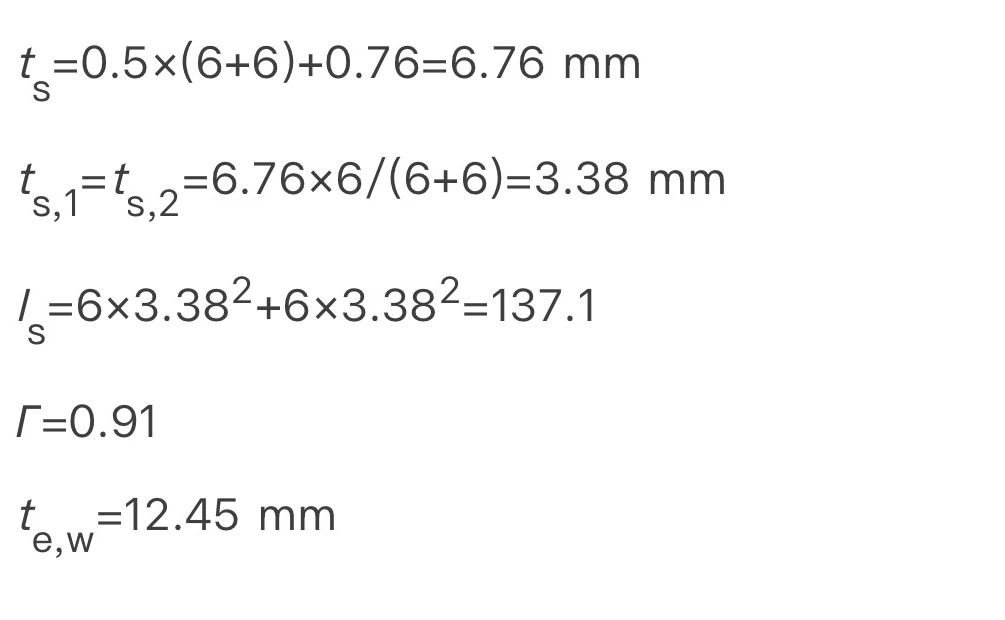
Original worked example, cropped from the supplied article. The numerical agreement checks the arithmetic under the stated assumptions; it does not establish a project's glass specification.
Why 12.45 mm Is Not a Design Approval
The source article subsequently reports a reduction to 12 mm, referring to a limitation in "some standards." That treatment should be checked against the precise clause and the method adopted for the project. It should not be applied as a general rule solely because the example uses two 6 mm plies.
Effective thickness also answers only part of the design question. Deflection, glass-ply stress, support details and any applicable post-breakage requirements require their own assessment.
The source cites ASTM E1300-09a. As checked on November 19, 2026, the ASTM directory lists E1300-24, and ASTM also publishes
E3491-26 on laminated-glass effective thickness. The responsible engineer should confirm the applicable edition and complete method.
The source also references Shanghai's DG/TJ08-56-2019 curtain-wall standard. Its local context should be retained; it is not a worldwide design requirement.
What to Record Before Confirming the Glass
A useful technical submission identifies:
- The exact interlayer product and supporting data-sheet revision.
- Temperature and load duration for each relevant load case.
- Glass design thicknesses, interlayer thickness and panel dimensions.
- Support conditions, calculation method and applicable standard edition.
- Separate results for deflection and glass-ply stress, with other required checks.
For an SGL project enquiry, include this information with the glazing schedule and drawings when contacting the project team. Confirm the proposed glass build-up and documentation for the actual order before relying on a generic interlayer description.
FAQ
Q: Can 11.3 MPa be used for every SGP calculation?
A: No. The cited value belongs to SentryGlas at 50°C and one minute. The exact product, temperature, duration and adopted design method must be confirmed.
Q: Does tₑ,w verify glass strength?
A: It represents deflection effective thickness in the model discussed here. It does not replace the stress assessment for each glass ply or other required project checks.
Q: Can the example be reused in a spreadsheet?
A: Its arithmetic can be reproduced, but a project spreadsheet also needs a verified method, correct inputs, units and applicable limits. A matching example is a calculation check, not project approval.